
Background
In April 2023, Foel Trawsnant Wind Farm was consented and will comprise of 8 turbines at 145m height to tip. The wind farm will be constructed to the north-west of Maesteg within the boundaries of Neath Port Talbot CBC.
Our proposals
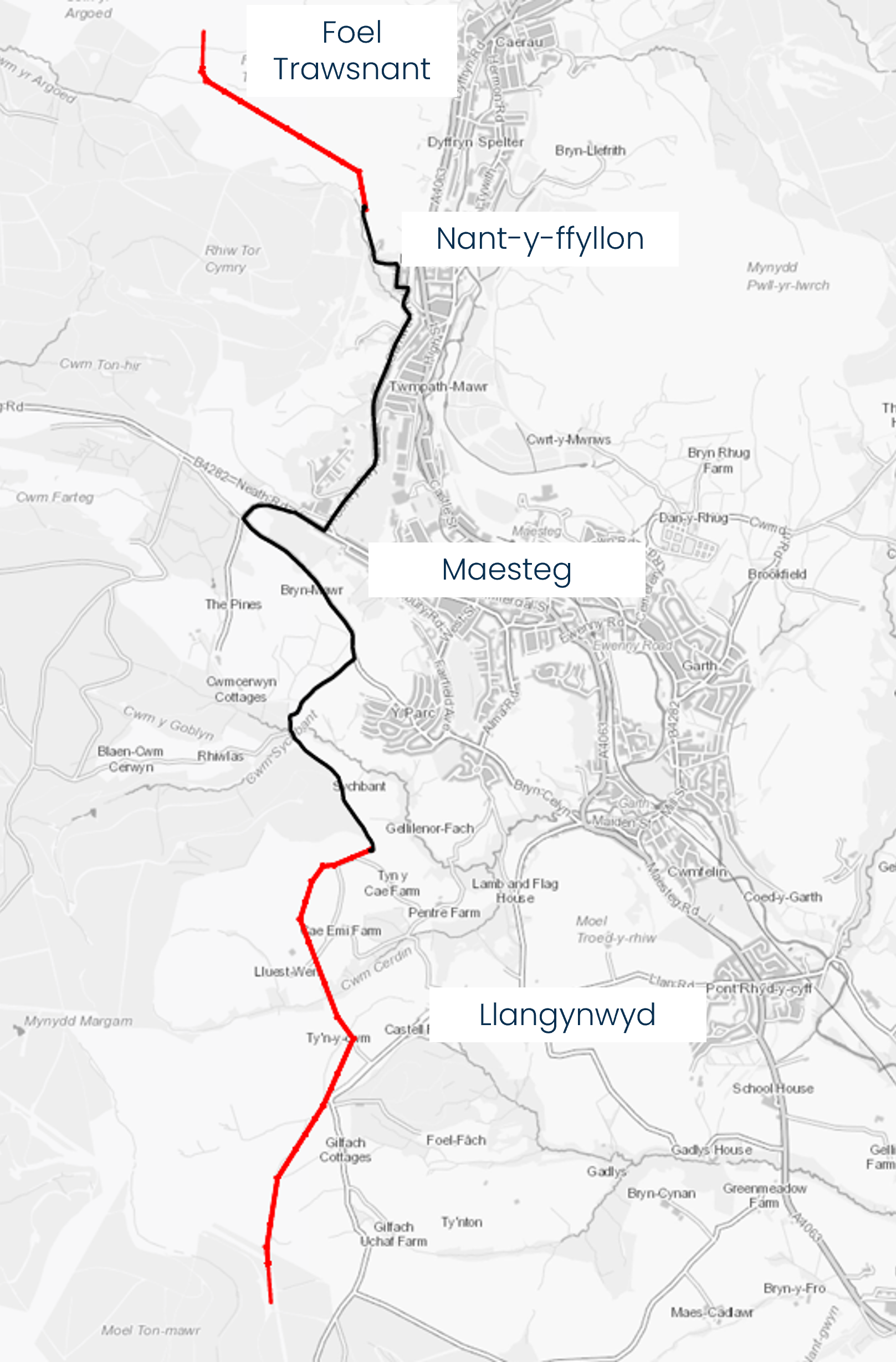
To connect the wind farm to the national grid, we’re bringing forward proposals for a 66kv connection route, predominantly within Bridgend CBC, made up of overground lines on wooden poles and underground cables.
The route will start and finish in Neath Port Talbot CBC, covering a total distance of around 10 km. Of this, 5.1 km will be underground with 4.4 km over head.
Whilst these proposals are being brought forward by Pennant Walters, it is National Grid Electricity Distribution (NGED, formerly Western Power Distribution) who would undertake the construction work.
This development is classed as a Development of National Significance (DNS) and, as such, the application will be submitted to Planning Environment Decisions Wales (PEDW), who will decide whether to grant permission.
Overhead Line
The overhead line would consist of wooden H poles (see image) at a height of up to 15 metres and will be constructed in two sections. The first would be a 1.5 km section from the Foel Trawsnant Wind Farm to just outside Nantyffyllon. The second overhead section would begin at Sychbant Farm and run for 3.1 km to an existing grid connection approximately 2 km southwest of Llangynwyd.
Wooden H poles consist of two single wooden poles, joined by a crossarm with bracing. At the end of a section of overground line there will be two sets of H-poles located side by side. Poles do not usually require concrete foundations, but pre-cast concrete blocks will be installed below ground to provide support.
The line will be as straight as possible unless certain features, such as trees, need to be avoided. Where this happens there will be angle poles, these are likely to also be H-poles, whenever an angle pole is used, cable stays will be fitted.
Underground Line
The underground section of the line will mostly follow the existing highway network for about 5.1 km between Nantyffyllon and Sychbant farm. There will be two ways in which this cable is laid underground.
Cable-laying methods
- Along the existing highway the works will be confined to the edges of roads and will follow standard practice when laying under highway infrastructure. Underground cables would be laid directly into a trench. At the surface, the trench would be at most 1.5m wide. Cables would be placed at the bottom and the area filled back in.
- Alternatively, cables could be placed within ducts, where available.
It is anticipated that highway works will take between five and six months to complete, and that works would take place between 7am and 7pm on weekdays and 7am and 1pm on Saturdays. NGED and Bridgend CBC Highways will co-ordinate appropriate traffic management measures for the works.
In some sections outside of the highway’s boundary a cable plough may be used, for example on the land above King’s Terrace, Nantyffyllon. It is anticipated that cable ploughing sections would take around two days to complete, with few traffic movements needed, reducing the impact on road users.
Further information on the proposals can be found on the exhibition boards on the consultation page and in the draft application documents section of this website.